




By: Bridget C Lewis ©2011
Today’s post is the second installment in the ‘unofficial’ MBA blog series. The last post discussed the ‘rightness’ of the decision to pursue an MBA, and the new challenges of scheduling it now presents. In today’s post, the MBA discussion continues, with a focus on why it is the right choice for me as a small business owner.
Before getting much further, here’s some of the background that affected this decision-making process. See, I did not always believe the MBA was right for me. Surprised? Don’t be. My entire career has been centered on teaching and learning. In my early career I was a school teacher for 13 years; I have an Associate’s Degree in elementary school education. A few years later I earned my Bachelor’s Degree in organization leadership. Soon I started feeling the pull back into the classroom so I started working on a Master’s Degree in middle school education. Halfway through that program I changed my mind. Why? …Because by then I had fallen in love with HR and Training. I knew I wanted to continue my career in teaching and learning, but it had to be from a different perspective.
So, when I started this workplace learning consultancy, my initial degree contemplations focused on the fields of Organizational Leadership, Instructional Design and Technology and Human Resources and Organizational Development. That’s right. I did not even think of an MBA degree. But the more I worked on my business plan, the more it became clear that I was missing a certain amount of business savvy. This forced me to consider the question: Is it reasonable to expect success as a business owner if you’re learning business skills on the fly?
There is a plethora of information readily accessible on the Internet describing the reasons startup businesses fail. One in particular – Why Do Most Business Startups Fail? – discusses ten reasons for this phenomenon and guess what? Poor execution is at the top of that list. That is not an accident. The article states:
“Strong execution-rather than a clever idea- is crucial to the success of new businesses. It stands to reason, therefore, that poor execution is the downfall of most startups that go bust. There are several ways you can avoid execution failure. First, you should conduct an honest evaluation of your skills and only pursue opportunities that are aligned with your strengths” (para. 2)
Startup entrepreneurs have to do an honest assessment of their skills and whether these skills are enough to reasonably turn an idea into success. Part of the assessment relates to subject matter expertise. How much do you know about your trade, line of business or industry? The other part of the assessment relates to business acumen. How ready are you to undertake the different facets of running a business? In truth, unless you have previous experience running a business, or have been around the startup block a few times, it is very likely that you are lacking the business acumen to create and sustain success.
In addition to knowing your capabilities, as a startup entrepreneur you cannot underestimate the importance of the business plan. I learned early in the game from all my mentors, you cannot forgo the business plan! Taking the time to do the research and putting a framework around your business is a critical component to success. They were right. But guess what? Not only do I have a solid business plan, but the process helped me face some truths about myself… one in particular my readiness – or unreadiness – for this massive undertaking.
Enter the MBA. So what makes it so right… for me of course? First take a look at the typical MBA curriculum. It doesn’t matter where you do your MBA, any program worth its salt will include courses in Economics, Accounting, Finance, Marketing, Strategic Planning, Research and Statistics, Operations, and Business Law. Which one of these areas can the entrepreneur succeed without? I dare say, insufficient knowledge or experience in any one of these areas makes success questionable at best. Oh, and by the way, Management, Leadership and Human Resources are also included in the curriculum.
So as I read the article – Why Do Most Business Startups Fail? – I began to look at the reasons for failure, and how the MBA degree might help minimize failure. The table below summarizes my views.
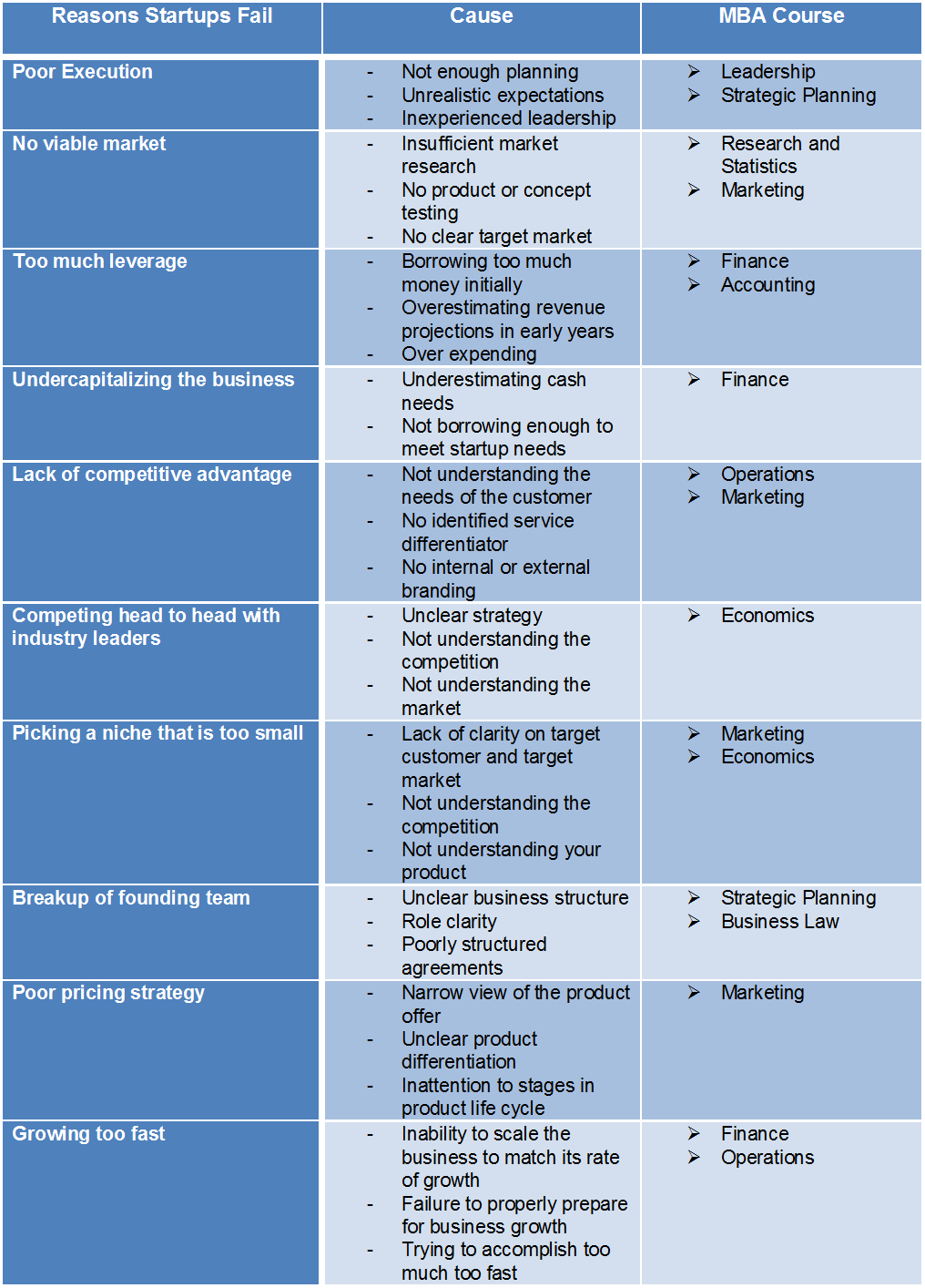
If you are an entrepreneur you know our nature. We are eager people. We get into the ring excited about our business venture, envisioning success from the start. However, sometimes we might need a reality check. Let’s face it, not all ideas lend themselves to great success. But, for the ideas with promise, don’t short yourself on business acumen – especially if you are like me, throwing your hat in the ring for the first time. Find a way to gain that knowledge. You’ll be better positioned and before long the experience you will gain in the trenches will make you a subject matter expert. What better feeling is there knowing that you know, that you know?







Planning is essential. Not everyone believes it is necessary, but in my view you can’t expect to succeed without having a plan. I know in my case I’m not lucky like that. I just read this blog post by Tim Berry and was pleased to see he agrees with me! Check out his post:
http://timberry.bplans.com/2010/12/can-you-pick-the-entrepreneurs-from-the-crowd.html